

Black Holes and the End of the Universe

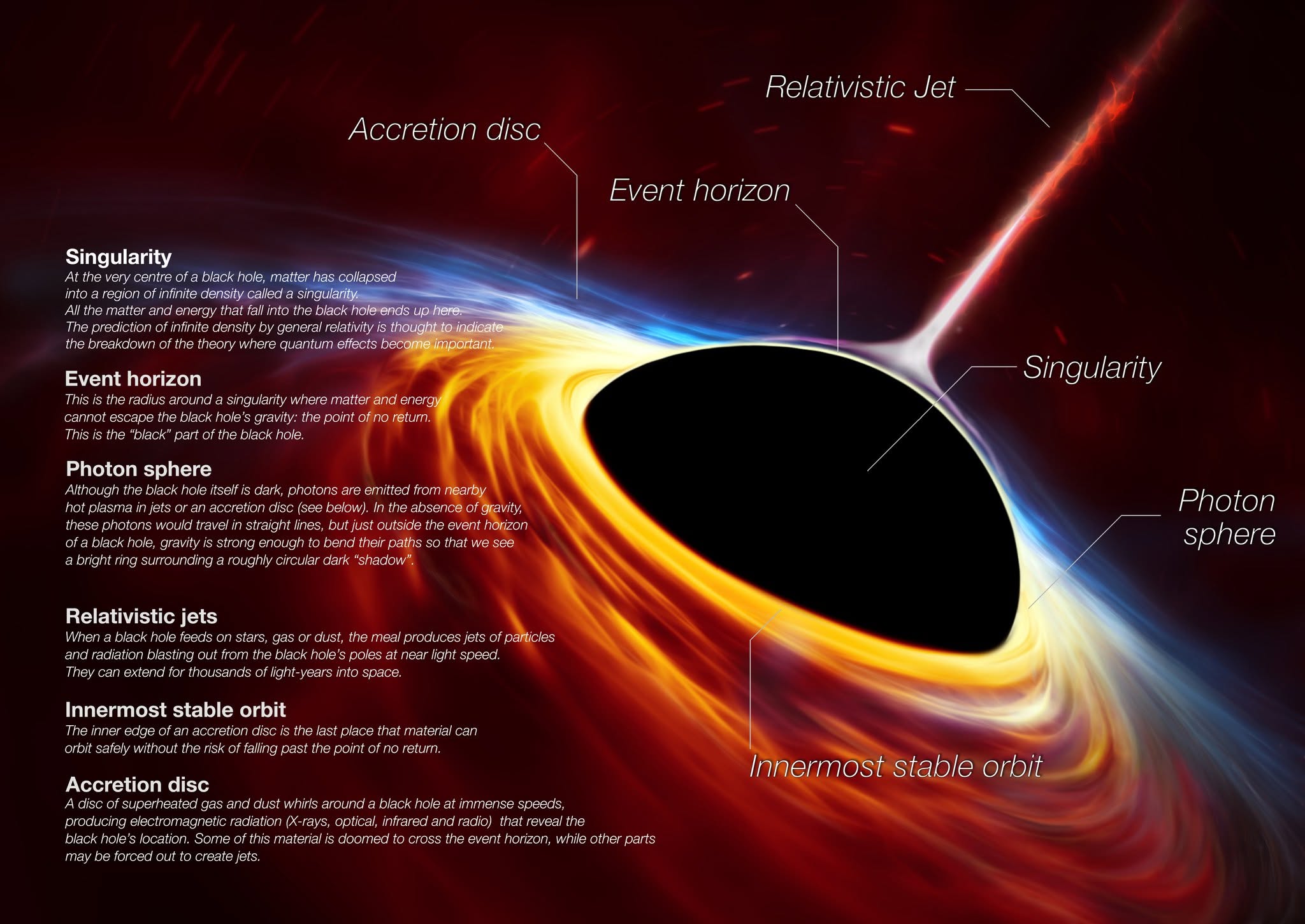 The University of Melbourne recently hosted a public lecture "Monsters in the math: Black holes at the end of physics" by Dr Matt O'Dowd. Dr O'Dowd is an astrophysicist at City University of New York, and most famous as the writer and director of the YouTube Channel PBS Space-Time. With some 500 people in attendance, it was a fairly high-level and historical presentation, covering many of the great contributors to the subject, including Newton, the underrated Mitchell (who coined "Dark Star"), Cavendish, Eddington, Chandraseker, and concluding with Hawking radiation, which, if true, means that everything is lost, which is the ultimate end of the universe. The "monsters", such as they were, included divide by zero possibilities in Newton's universal gravity law, and the same again in the Schwarzschild metric, which occur at the Event Horizon and the Central Singularity.
The topic reminded me of another physicist, Brian Schmidt, whose presentation I attended over a decade ago, which included contributions to the return of static universe, an argument expressed by a third cosmologist that I had the opportunity to listen to. Expressed simply, the idea is that gravity will pull nearby galaxies closer together, whereas those with sufficient distance and velocity will increasingly move farther apart, resulting in a universe of tightly packed galaxies (a very bright night sky) but with enormous distances between these clusters. Of course, in this case, it isn't literally a static universe; rather, the effect of accelerated cosmic expansion will erase evidence of the Big Bang, making it appear static. An obvious issue I have with this is that almost every large, mature galaxy hosts a supermassive black hole at its centre, and these black holes tend to be proportional to the size of the galaxy. Combined with Hawking Radiation, one is drawn to the uncomfortable conclusion that, ultimately, everything reaches a complete thermal death, in which all matter dissolves into a featureless sea of radiation.
Seriously, it's a very long time in the future (a mere 10^78 years according to recent calculations), and there are smarter minds than mine working on this problem, and many physicists think that quantum information will be retained. whether through the holographic principle, subtle quantum entanglements, or highly condensed quantum gravity cores. Nevertheless, it is all part of the wider question of the ultimate fate of the universe and, as such things are, a lot of the fate of the universe has to do with the beginning of the universe. Up until 1965, the two competing theories were the Big Bang Theory, initiated in 1927 by Georges Lemaître, and Fred Hoyle's Steady State Theory from 1948. Hoyle's theory argued that the universe continually expanded but remained statistically unchanged as new matter is constantly created from "white holes" where, from massive, compact bodies, explosively created new matter into the universe, rather like a miniature Big Bang.
Hoyle's theory fell out of favour following the 1965 discovery by Arno Allan Penzias and Robert Woodrow Wilson of cosmic microwave background radiation, which was predicted by the Big Bang Theory, but could not be accounted for by the Steady State theory. However, that is not the end of it all; Stephen Hawking has hypothesised that when it is possible for a black hole to generate a gravitational singularity and form a new universe; a "baby universe" as it has been called, and arguably our own universe may have been born from a black hole in another "parent" universe - although, not to be confused with our own universe in its infancy. Of course, a baby universe is entirely hypothetical and notably is strongly opposed by Roger Penrose who, following the Hawking-Penrose Singularity Theorems, argues that that black holes are a dead-end singularity.
Instead, Penrose argues for Conformal Cyclic Cosmology (CCC), a cyclical model where our universe expands into a uniform state where all mass decays, which then triggers a new Big Bang and starts the cycle over. This is cyclical like traditional "big crunch" theories, where the universe continues expanding under a critical point then, like an elastic band, returns to a single point - which several cosmologists have inferred that time would go backward as space shrinks, it does not involve a return to a single point. Instead, mass decay reduces scale, ultimately rendering an infinitely large, empty universe mathematically identical to an infinitely small, dense Big Bang.
The ultimate fate of the universe remains unknown, but it depends on the geometry of space-time and the behaviour of dark matter and dark energy. Notably, in all cases, black holes are a pivotal structure at the end of the universe.
1) Heat death of the universe has been the dominant theory for a while; the universe expands at an accelerating rate, with galaxies separating so far apart that gravitational forces between them are too weak. Eventually, stars burn through their fuel, and matter dissolves into an expanse of subatomic particles. Black holes will be the final stage of the universe; after the last stars burn out, the universe will enter the Black Hole Era, finally evaporating via Hawking Radiation.
2) If, however, dark energy is weakens over time then gravity stops and reverses the universe's expansion; resulting in a big crunch, where galaxies collide, space compresses, and the universe grows incredibly hot as cosmic microwave radition compresses, eventually becoming a fiery singularity (and Heraclitus again gets the last wry laugh). In this scenario, black holes stop being isolated vacuums and become the dominant cosmic structural elements, merging, sucking in star systems and galaxies, and eventually becoming one universe-sized single black hole.
3) If, however, dark energy increases in strength over time, then cosmic acceleration could overpower galaxy clusters, then stars and planets, and finally atoms themselves, ripping apart the fabric of space-time itself. Black holes in this scenario will lose their source of stars and matter, and then eventually even the gravitational forces that hold them together is insufficient to prevent them from being ripped apart.
4) Finally, there is the argument that the Higgs field is actually a "false vacuum", a bubble, an unstable energy state, which could collapse at any moment, expanding and rapidly destroying everything in its path without warning. In vacuum decay, Black Holes are potentially the trigger that causes the end of the universe due to their space-time curvature, and then the instant victim.
File Attachments:

- lev.lafayette's blog
- Log in to post comments